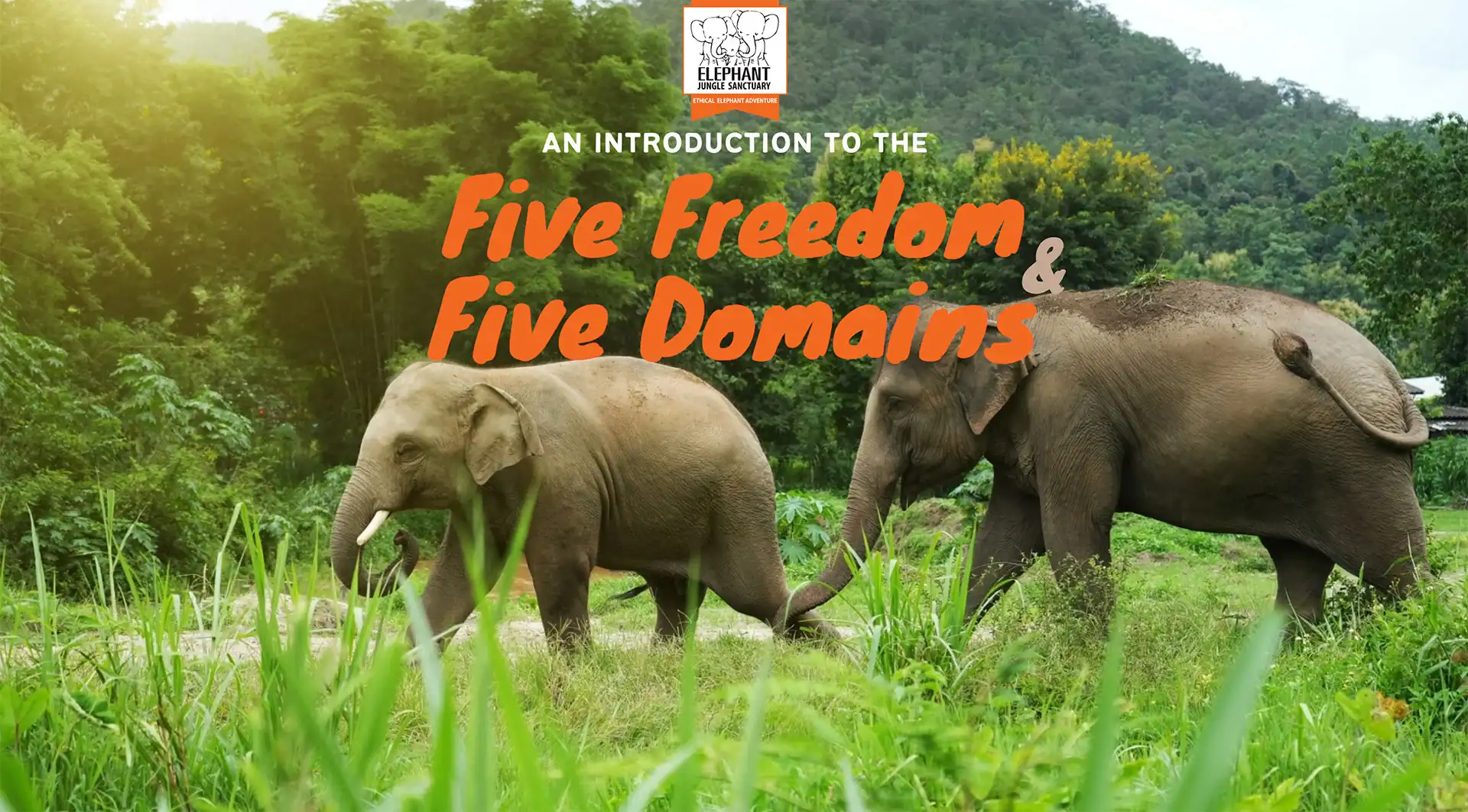
The protection and promotion of elephant welfare is a core value of Elephant Jungle Sanctuary. We pride ourselves on our knowledge of, and adherence to, modern standards of animal welfare. In addition, we believe that to improve animal welfare on a national, or even global, scale, information about theories of animal welfare and the associated frameworks for welfare assessment should be freely accessible to everybody. In this post, we will discuss two of the most influential and widely used models of animal welfare.
Although animals have been domesticated and lived alongside humans for millennia, animal welfare as a scientific concept is a shockingly recent development. Attempts to adequately define animal welfare – and to identify and codify its constituent elements for the benefit of domestic animals – began in earnest only in the latter half of the 20th Century. While some components of welfare are both intuitive and easily apparent to any animal owner or casual observer, others – in particular, psychological needs – may be less obvious, and thus a standardised, objective set of standards is vital for ensuring animals’ fundamental needs are met.
The importance of animal welfare was highlighted in 1964, when an activist named Ruth Harrison published a book entitled ‘Animal Machines.’ This book exposed to the public the animal cruelty associated with industrialised agriculture (or “factory farming”) practices in Britain. Information contained within Harrison’s book, combined with public outrage at its contents, prompted the creation of a committee to officially investigate the welfare of farm animals in the UK. The resulting report, known as the “Brambell Report,” stated that animals kept by humans should have the freedom “to stand up, lie down, turn around, groom themselves, and stretch their limbs.” These guidelines became known as Brambell’s Five Freedoms, and although they were specific to an industrialised agriculture setting – and may appear to a present-day reader to be both fundamental and self-evident – at the time of publication, the mere creation of a set of formalised guidelines for animal welfare was a landmark development.
By 1979, Brambell’s Five Freedoms had been developed significantly, and formally codified into a model of animal welfare which is now known simply as the ‘Five Freedoms’. Each Freedom benchmark is accompanied by a “Provision” which aims to offer an explanation of practical measures by which the associated Freedom may be attained. The Five Freedoms are listed below in bold, accompanied by their companion Provisions:
Five freedoms of animal welfare
1. Freedom from thirst, hunger, and malnutrition
By providing ready access to fresh water and a diet to maintain full health and vigour.
2. Freedom from discomfort and exposure
By providing an appropriate environment including shelter and a comfortable resting area.
3. Freedom from pain, injury, and disease
By prevention or rapid diagnosis and treatment.
4. Freedom from fear and distress
By ensuring conditions and treatment which avoid mental suffering.
5. Freedom to express normal behaviour
By providing sufficient space, proper facilities, and company of an animal’s own kind.
In the context of elephant welfare, in order to adequately meet an elephant’s complex physical, psychological, and social needs, according to the Five Freedoms model, a number of things must be provided to the animal. These include consistent access to fresh water, a varied, healthy diet tailored to the needs of the individual, and nutritional supplementation if necessary. A safe, secure, location with adequate space for roaming, foraging, and physical activity, comprised of a varied landscape, and featuring natural vegetation, should also be provided. Elephants should, at all times, have access to a choice of shelter to protect them from weather conditions, including rest areas and shelters in which they can sleep comfortably, which minimal interference from human activity and environmental stimuli such as excessive noise or artificial light. Mahouts should be sufficiently qualified and experienced to ensure the safety of all animals and humans, and should monitor the elephants daily for signs of distress, social issues within the herd, or physical illness. Access to immediate veterinary care should be available, and frequent routine health checks should be provided by veterinary staff to ensure prevention, or early diagnosis and treatment, of any disease or injury. Furthermore, proactive measures such as the administration of vaccines and anthelmintics are vital to ensuring an elephant’s health. Elephants should be provided with adequate space and freedom to choose whether to engage socially or roam independently, should not be forced to perform any unnatural behaviours, and should be restrained only when necessary to ensure the safety and wellbeing of themselves or others, such as during certain veterinary treatments.
Since its formulation, the Five Freedoms model of animal welfare has been profoundly influential, and has served as the basis for countless research articles, animal care protocols, and animal protection laws worldwide. Despite its near-universal adoption, the Five Freedoms paradigm has received criticism, most notably due to its limitations in scope. Perhaps unsurprisingly, due to its conception as an corrective measure to immediately alleviate the appalling conditions experienced by animals in an industrialised agricultural setting, the focus of the Five Freedoms model is, principally, to minimise, resolve, or remove the negative physical and mental states which can occur in domestic and captive animals as a result of harmful environmental conditions and stimuli. While this endeavour is undoubtedly noble in nature, the implementation of the Five Freedoms alone can, at best, alleviate negative states and lead to a neutral state of being. Our current understanding of animal psychology demonstrates that, while the removal or minimisation of negative physical and mental states is important, animal welfare management protocols should also promote positive experiences and environmental stimuli. Additionally, positive physical and mental states should be emphasised during the formulation of practical animal care guidelines, and incorporated into any model aimed at measuring overall animal welfare of an individual or population.
What is five domains of animals?
One model of animal welfare which aims to move beyond the Five Freedoms by incorporating positive physical and mental states is the similarly named Five Domains Model. First proposed in 1994, the Five Domains Model expands on the Five Freedoms to systematically measure welfare outcomes. This updated reformulation of the original theory allows for a more thorough exploration of the psychological state of an animal than the Five Freedoms. It also reinforces the idea that emotional needs are no less important than physical needs for overall welfare. The Five Domains (shown in a somewhat simplified form) are as follows:
Five domains of animal welfare
1. Nutrition
2. Environment
3. Health
4. Behaviour
5. Mental State
The first four Domains are predominantly ‘Physical/Functional’ Domains, and can be used to identify impacts from both negative and positive stimuli. Nutrition, Environment, and Health may be grouped as ‘Survival-Related Factors,’ and evaluate the presence and effects of such things as adequate food and water, pleasantness of environment, overall physical fitness, and the presence or absence of disease. ‘Situation-Related Factors’ can be grouped under the Behaviour Domain, and allow assessment of negative behavioural factors, such as the restriction of natural behavioural expression, as well as positive factors, such as the encouragement of expression of rewarding behaviours. The fifth ‘Mental State’ Domain reflects the overall mental state of an animal by evaluating the previous four Domains. The negative and positive factors identified in Domains 1-4 are assessed together in the fifth Domain to ascertain their accumulated impact on welfare. The overall ‘Affective Experience’ in the Mental State Domain equates to the overall welfare status.
While the aims of the Five Freedoms and the Five Domains are different, the models can be viewed as complementary. The Five Freedoms focuses on the minimisation or removal of negative physical or mental states, while the Five Domains Model clarifies that, in order to incorporate positive welfare states, animals must be provided with opportunities to have positive experiences. The overall mental state of any domestic animal can benefit from predominantly positive states, such as pleasure, vitality, anticipation, and satiation, while negative states, such as fear, boredom, hunger, pain, and frustration, should be reduced as much as possible. The environment in which an animal lives should be carefully designed to not only provide necessities such as safety, comfort, and adequate shelter, but also to encourage the animal to express natural and rewarding behaviours.
Both the Five Freedoms and Five Domains models have undergone significant revisions and updates since their original formulation, and are continually being reviewed to improve their clarity and relevance. Many other models of animal welfare and assessment frameworks have been formulated, including the ‘Five Provisions/Welfare Aims’ paradigm, which is inherently linked to the original Five Freedoms model, but eliminates the “Freedoms” as problematic terminology, opting instead to focus on the accompanying provisions, paired with animal welfare aims, such as “Minimise thirst and hunger and enable eating to be a pleasurable experience.” (Paired with the ‘Good Nutrition’ Provision.) As humans continue to expand our understanding of animal biology, behaviour, and psychology, our ethical concerns regarding the welfare of domestic and captive animals will inevitably continue to evolve. The original Five Freedoms model of animal welfare may require supplementation to maintain its relevance, but it is invaluable as a foundation for theoretical thought, and the positive impact it has had – both directly and indirectly – on the lives and wellbeing of countless animals over the course of the past six decades cannot be understated.
Elephant Jungle Sanctuary adheres to the Five Freedoms principles and uses an updated version of the Five Domains paradigm to assess the welfare of the elephants we care for on a routine basis. We believe wholeheartedly in the elimination of negative welfare states and the implementation of positive welfare states, and we do our best to create environments which promote enriching experiences and encourage natural, rewarding behaviours. Models such as the Five Freedoms and Five Domains are extremely valuable as guidelines for animal care, and the EJS team uses these as a foundation, incorporating complementary knowledge sourced from contemporary scientific literature and the latest in evidence-based veterinary care and husbandry practices.
Reference
Beausoleil, N. J., Jones, B., Littlewood, K. E., McGreevy, P. D., McLean, A. N., Mellor, D. J., & Wilkins, C. (2020). The 2020 Five Domains Model: Including Human-Animal Interactions in Assessments of Animal Welfare. Animals, 10(10): 1870.
https://doi.org/10.3390/ani10101870
Beausoleil, N. J., Mellor, D. J. (2015). Extending the ‘Five Domains’ Model for Animal Welfare Assessment to Incorporate Positive Welfare States. Animal Welfare, 24(3): 241-253.
https://doi.org/10.7120/09627286.24.3.241
Broom, D. M. (2011). A History of Animal Welfare Science. Acta Biotheoretica, 59(2), 121-137.
https://doi.org/10.1007/s10441-011-9123-3
Companion Animal Psychology. (2017). The Five Domains Model Aims to Help Animals Thrive.
https://www.companionanimalpsychology.com/2017/01/the-five-domains-model-aims-to-help.html
Grandin, T. (Ed.). (2021). Improving Animal Welfare: A practical approach. 3rd edition. CAB International, Oxfordshire, UK.
Mellor, D. J. (2016). Moving Beyond the “Five Freedoms” by Updating the “Five Provisions” and Introducing Aligned “Animal Welfare Aims”. Animals (Basel), 6(10): 59.
https://doi.org/10.3390/ani6100059
Mellor, D. J. (2016). Updating Animal Welfare Thinking: Moving Beyond the “Five Freedoms” towards “A Life Worth Living”. Animals (Basel), 6(3): 21.
https://doi.org/10.3390/ani6030021
Michigan State University. (2019). The Five Freedoms: A History Lesson in Animal Care and Welfare.
https://www.canr.msu.edu/news/an_animal_welfare_history_lesson_on_the_five_freedoms
Webster, J. (2005). Animal Welfare: Limping towards Eden. Blackwell Publishing, Oxford, UK.